
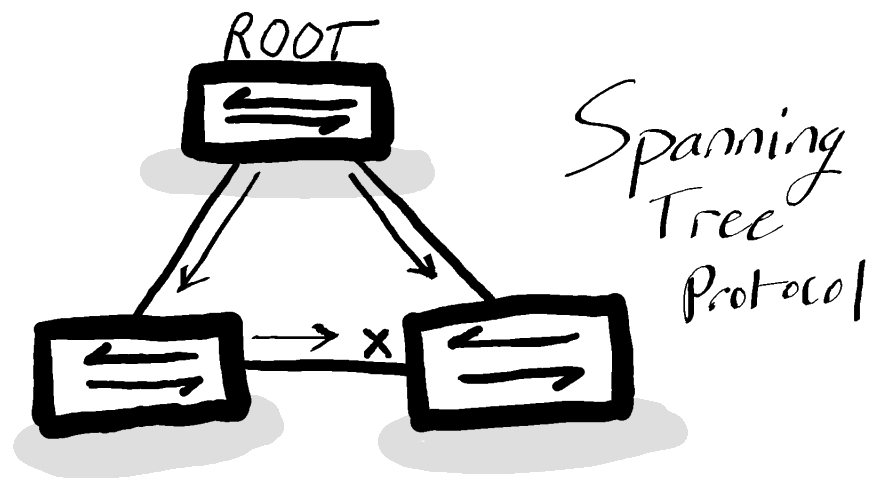

BPDU’s are sent out designated ports and the root cost is added by the receiving device based on the port speed on which it was received. The switch then sends BPDU’s out its own designated ports with the added cost from the interface it received its prior BPDU on.

If we want to traffic engineer so that SW5 sends it’s traffic to SW4 instead, we can see where we should change the cost value and where it won’t have any impact. If we change the links on SW3 or SW4 going towards SW5 there won’t be any change in SW5’s root path cost. This is because the cost is only added when a switch receivesa BPDU. So we can change the links on SW5, or the links on SW3/4 that are facing SW2.
Changes on non-portfast links trigger a TCN – Topology Change Notification. These occur when a port goes into forwarding or from forwarding/learning into the blocking state.
Rapid STP takes under a second to converge, and combines the idea of Disabled/Blocking/Listening into:
Discarding —> Learning —> Forwarding (Under 1 second)
This is because of a fundamental difference between STP and RSTP.
RSTP uses a Proposal and Agreement process while STP uses Listening and Learning process.
These difference processes hinge on the fact that with STP only the bridge can send a BPDU which is transferred by others and in RSTP all bridges can forward BPDUs.
If a TCN occurs in a regular STP environment, it has to be sent all the way to the root bridge, then the root bridge has to send a BPDU that is propagated all the way up the spanning tree environment.
Topology changes are handled slightly different from STP. First, the goal of RSTP is fast re-convergence. Since ports are assumed to transition to forwarding relatively fast, simply increasing MAC address aging speed is not enough. Thus, when a topology change is detected, RSTP instructs the bridge to flush all MAC address table entries. With Ethernet, this process results in unconstrained flooding until the moment MAC addresses are re-learned. The bridge detecting a topology change sets the TC (Topology Change) bit in all outgoing BPDUs and starts sending BPDUs with the TC bit set upstream through the root port as well. This marking lasts for TCWhile=2xHelloTime seconds and allows the detecting bridge the start the flooding process
 The Packet Blog
Leave a comment